
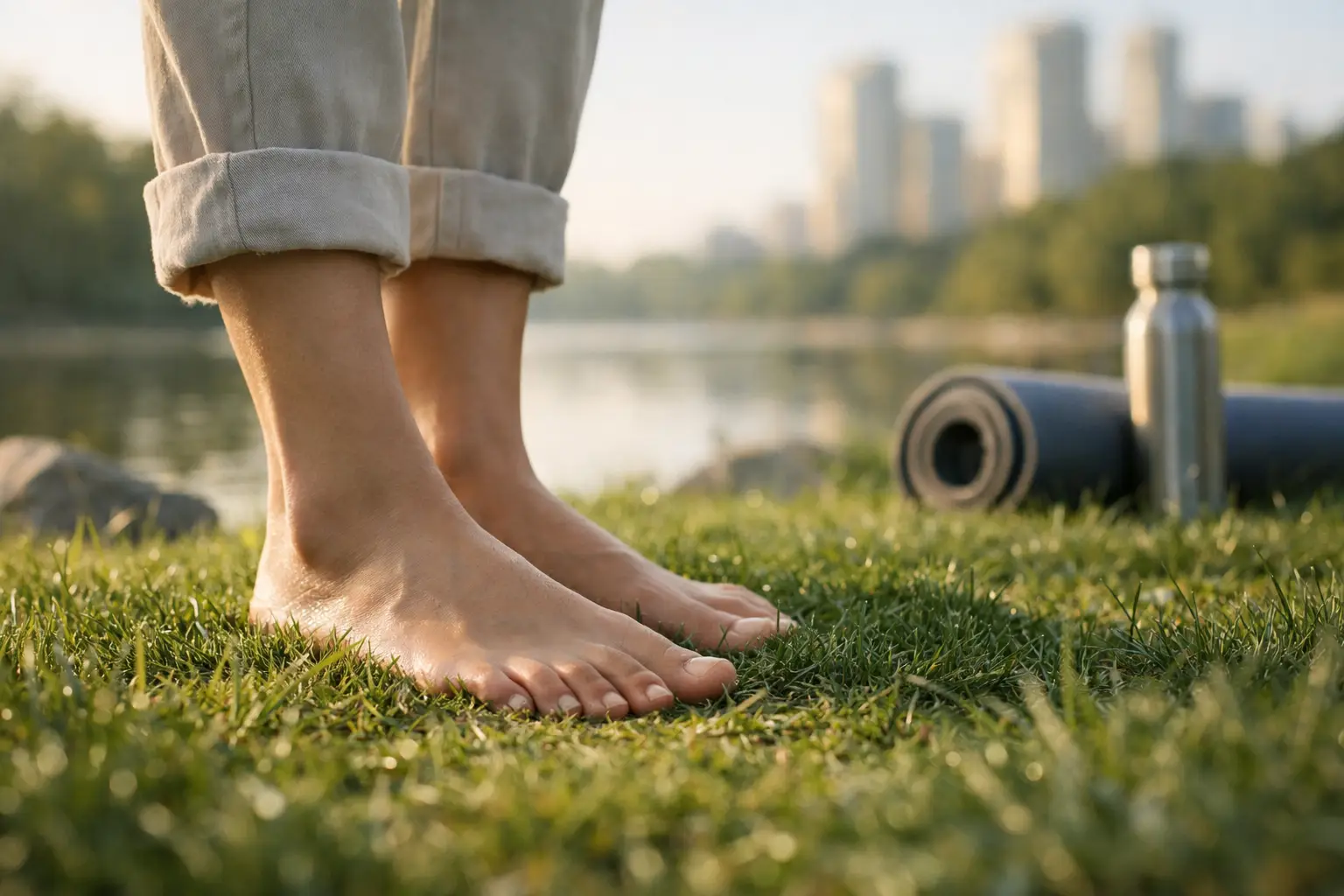
The quickest way to practise earthing is also the least complicated: step outside, place bare feet on natural ground and stay long enough to notice that you have arrived. Not mentally, not as another task to complete, but in your body. Beneath constant notifications, artificial light and the pressure to keep moving, the Earth offers a steady reference point – one that asks nothing except your presence.
Earthing, sometimes called grounding, is the intentional practice of connecting your body and awareness with the natural electrical field of the Earth. For many people, it is both a physical ritual and an energetic reset. It can be a useful way to pause, sense your own biofield and reclaim a little more sovereignty over the pace and input of daily life.
How to Practise Earthing: Begin with Direct Contact
The traditional practice is simple. Choose a clean, safe area of soil, grass, sand, stone or an untreated natural surface. Remove your shoes and socks, stand or sit comfortably, and allow your bare skin to touch the ground. A garden, park, beach or quiet patch of woodland all work beautifully.
Start with five to ten minutes. If you have been indoors all day, are feeling scattered after screen time, or have just travelled, even a brief pause can create a noticeable shift in your awareness. Rather than trying to force an experience, pay attention to what is already there: the temperature beneath your feet, the texture of the ground, the rhythm of your breath and the sensations moving through your legs.
You may prefer to walk slowly rather than stand still. Barefoot walking can make the practice feel less formal and more integrated into life. Let your heel meet the ground, then the sole, then the toes. Feel the simple exchange of weight and support. The point is not to perform grounding perfectly. It is to become receptive.
Make Earthing an Energetic Practice, Not Just a Habit
Direct contact with nature is powerful, but attention gives the ritual depth. Before you step outside, set a clear intention. You might silently ask to release the energetic residue of the day, return to your centre, or strengthen your sense of personal boundaries.
As you stand on the Earth, imagine a current of stable, mineral-rich life-force energy rising from the ground through your feet. Let it move through your ankles, legs, hips and spine. With each exhale, picture excess mental noise, tension or borrowed emotional energy moving downwards to be composted by the Earth.
This visualisation is not about denying difficult feelings. It is about giving them somewhere safe to move. A grounding practice can help you meet a charged conversation, a demanding workday or a crowded environment with greater discernment. You are not trying to become unaffected by life. You are practising how to remain present within it.
If visualisation does not resonate, use a more sensory approach. Notice five things you can see, four things you can feel, three things you can hear, two things you can smell and one thing you appreciate. This brings consciousness out of looping thought and into immediate contact with your environment.
Choose the Right Time for Your Rhythm
Morning earthing can set the tone for the day. Before checking messages, take your tea outside, place your feet on the grass and breathe with the early light. This can become a powerful declaration that your nervous system, attention and energy belong to you before they belong to the digital world.
Earthing at the end of the day has a different quality. It creates a threshold between external demands and rest. If you work with clients, care for others or spend hours in high-stimulation spaces, consider a short grounding ritual before entering your home or beginning your evening practice. Wash your hands, stand barefoot outdoors and consciously release what is not yours to carry.
There is no universal ideal duration. Twenty minutes may feel nourishing one day, while three intentional minutes may be all that is realistic on another. Consistency matters more than intensity. A practice you can return to several times each week will usually reveal more than an occasional, elaborate ritual.
Work with Nature in All Seasons
Earthing is often pictured as a summer practice, but it does not need to disappear when the weather turns. In Britain, a damp lawn, cold stone path or sandy shoreline can offer a bracing, clarifying experience. The key is to respect your body and the conditions.
On colder days, keep the practice short. Wear warm layers, choose a dry and safe area, and focus on a few slow breaths with your feet on the ground. You might sit on a natural surface with a blanket around your shoulders, rest your palms against a tree, or spend a few quiet moments tending plants and touching the soil.
A tree can be an especially supportive anchor when bare feet are impractical. Stand with your back against its trunk or place both hands on the bark. Feel its structure, its rootedness and its unhurried relationship with time. This is not identical to skin-to-Earth contact through your feet, but it can still be a meaningful way to orient your awareness towards the living field around you.
Bring Grounding into Technology-Heavy Days
Many people seek earthing because modern life can feel electrically and energetically crowded. Whether you frame that experience through EMF awareness, nervous-system overload or simple sensory fatigue, the practical response is similar: create regular moments of reconnection with your own body and the natural world.
Try pairing outdoor grounding with clear technology boundaries. Put your phone on aeroplane mode for ten minutes. Leave it indoors while you water the garden. Take a barefoot pause between video calls rather than scrolling through the gap. These small choices help interrupt the pattern of constant energetic consumption.
For those who want to explore their relationship with frequency more intentionally, earthing can sit alongside water rituals, breathwork, meditation and conscious use of supportive wellness tools. At Crystal Water Experience, the wider teaching is not that one object or ritual will do the work for you. It is that repeated, intentional practices can strengthen your capacity to observe your energy, make cleaner choices and return to coherence.
What Earthing Can and Cannot Promise
People often describe feeling calmer, clearer or more settled after time in nature. These experiences are valid personal observations, and they are worth tracking. Keep a short journal after your practice: note your mood, mental pace, body sensations and quality of sleep. Over several weeks, your own patterns will tell you more than a generic promise ever could.
At the same time, earthing should not be treated as a cure-all or a replacement for medical care, mental-health support or practical changes in your life. Scientific research into grounding and its specific health effects is still developing, and strong claims deserve healthy discernment. Let the practice support your wellbeing without placing impossible expectations upon it.
If you have reduced sensation in your feet, balance concerns, open wounds, severe allergies or a health condition that affects circulation, choose a safer version of the ritual and seek appropriate professional guidance where needed. Grounding should feel supportive, never like something you have to endure to prove your commitment.
Create a Simple Earthing Ritual You Will Keep
A sustainable ritual can be as uncomplicated as this: go outside, make skin contact with a natural surface, take ten slow breaths and ask, “What belongs to me in this moment?” Then notice the answer without judgement.
Some days, the answer may be tiredness. On others, it may be grief, gratitude, creativity or the need for a firmer boundary. The Earth does not demand that you become more polished before you connect with it. It meets you in the reality of your body, exactly where you are.
Let that be the quiet power of your practice. Each time your feet touch the ground, you are rehearsing a deeper remembrance: you can return to your centre, clear your field and choose your next step from a more rooted place.