
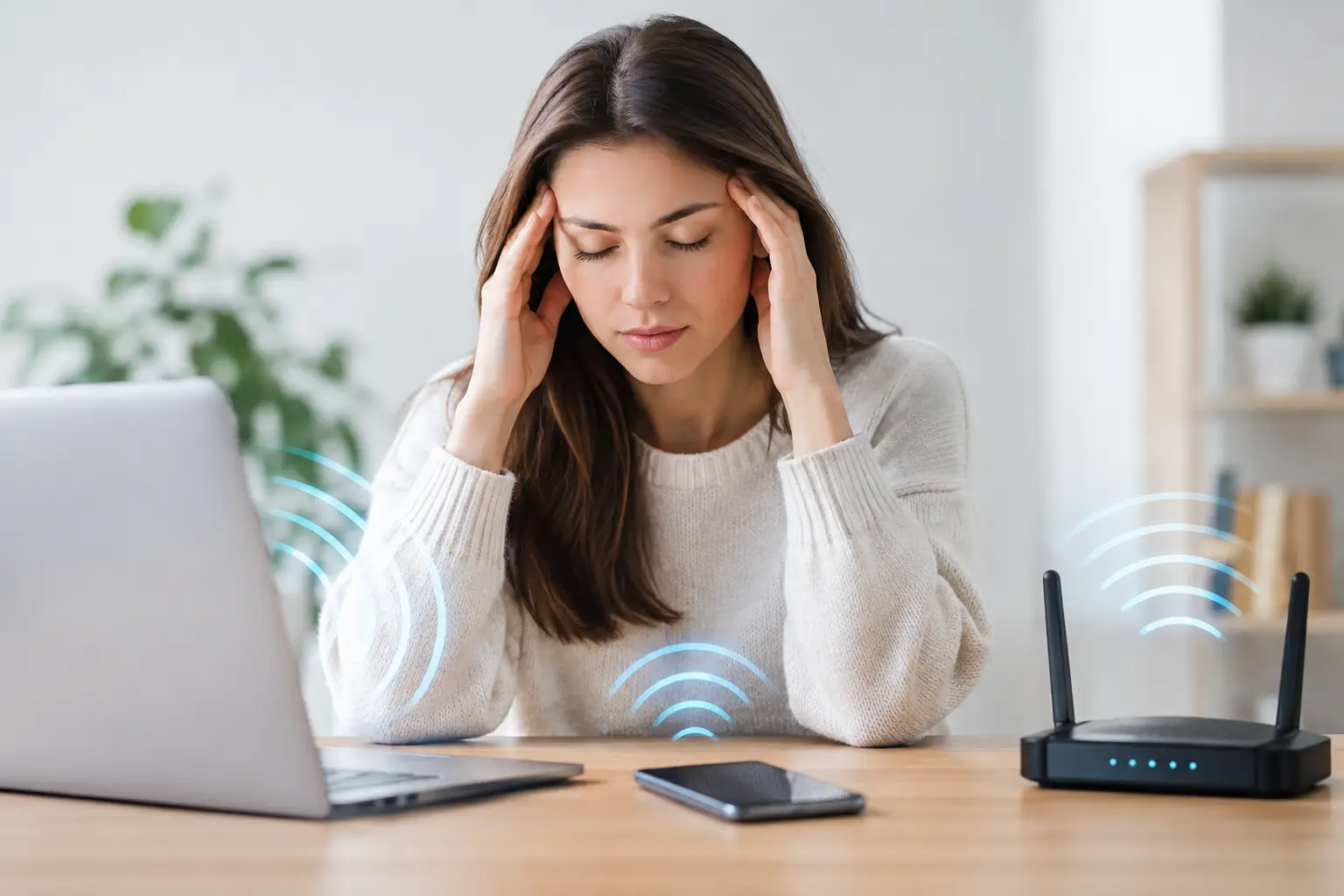
Your mobile phone is charging beside the bed. The Wi-Fi is still on. A laptop has followed you from work into the evening, and your nervous system has had very little invitation to come home to itself. For many sensitive people, the question is not abstract: can EMFs affect wellbeing in a way they can actually feel?
The honest answer is that it depends. EMF is a broad term, individual sensitivity varies, and research does not support treating everyday technology as a simple explanation for every symptom. Yet many people notice that constant connectivity, screen habits, poor sleep, buzzing environments and a lack of time outdoors can leave them depleted, scattered or less grounded.
At Crystal Water Experience, we view this as an invitation to practise energetic sovereignty. Rather than living in fear of technology, you can become more frequency-literate: observe your environment, understand your own signals, and make intentional choices that support coherence in your body, biofield and daily life.
Can EMFs affect wellbeing in everyday life?
Electromagnetic fields, or EMFs, are energy fields associated with electricity and wireless communication. They are part of modern life, arising from mains power, appliances, mobile phones, Bluetooth devices, wireless networks and many other sources. Not all EMFs are the same. Frequency, intensity, duration, distance and the setting all matter.
From a conventional health perspective, the strongest evidence-based concerns around technology tend to relate to behaviour and environment: disrupted sleep from late-night screens, reduced movement, prolonged sitting, mental overload, notifications and the pressure of continual availability. These effects can be deeply real, even when it is difficult to separate the role of the device itself from the habits built around it.
From an energetic perspective, many people also describe a subtler experience. They may feel less settled after hours near multiple devices, more reactive in a dense urban environment, or clearer after time barefoot on the earth, in nature or away from wireless demands. These observations are personal rather than a diagnosis. They are still worth meeting with curiosity.
Your system is not a machine that responds identically every day. Sleep, hydration, stress, nutrition, emotional load, hormones, your physical environment and the quality of your attention can all shape how resourced you feel. The useful question is often not, “Are EMFs the one cause?” but, “What patterns help me feel coherent, clear and vital?”
The difference between vigilance and awareness
There is a trade-off in any wellbeing practice. Awareness can restore agency; hypervigilance can drain it. If every plug socket becomes a threat, the nervous system may remain in the very state of alarm you are trying to ease.
Energetic discernment has a different quality. It is calm, practical and responsive. You notice that scrolling in bed leaves you wired, so you charge your mobile phone outside the bedroom. You recognise that back-to-back video calls flatten your concentration, so you take a few minutes between them to breathe, drink water and look beyond a screen. You do not need perfect control of every field around you to create a more supportive relationship with your environment.
This matters especially for people who already work with subtle energy, meditation, bodywork or healing practices. Greater sensitivity can bring valuable information, but it also calls for stronger foundations. Grounding, rest, nourishment and clear boundaries give intuitive perception somewhere stable to land.
Start with your own frequency audit
A personal audit is more useful than copying someone else’s routine. For seven to ten days, make small changes one at a time and record what you notice. Keep the process simple enough that you will actually do it.
Begin with sleep. Move your mobile phone away from the bed if possible, silence non-essential notifications and create a screen-free buffer before rest. Notice not only whether you fall asleep more easily, but how you feel upon waking: heavy or restored, rushed or present, foggy or clear.
Then look at proximity and duration. If you spend hours with a laptop on your lap or a mobile phone held close to your body, experiment with greater distance, regular pauses and a more considered workstation. Distance is a practical variable, and it often improves posture and breathing as well.
Finally, consider the energetic texture of the space. A room full of charging leads, bright screens, clutter and unfinished tasks can create a feeling of constant demand. Clearing one surface, opening a window, placing your feet on the ground or taking a conscious water pause may shift more than you expect. The aim is not to prove a theory. It is to learn the language of your own system.
Practices that support biofield coherence
You do not need to retreat from modern life to restore your centre. Small rituals can help you transition out of digital intensity and back into embodied presence.
Grounding is one of the simplest. Stand outside with bare feet on natural ground when conditions allow, or sit with both feet planted and bring your attention down through the legs. Breathe slowly enough that your exhale becomes longer than your inhale. Let your awareness move away from the buzzing perimeter of the day and into the weight, warmth and steadiness of the body.
Water can become another meaningful point of return. Before drinking, pause with the glass in both hands. Set an intention for calm, clarity or protection. This is not about forcing water to perform a miracle. It is about making hydration a moment of relationship, attention and water consciousness rather than another task completed while distracted.
A brief boundary practice can also be powerful before using technology. Place one hand over the heart and one over the lower abdomen. Acknowledge the devices and demands around you, then state silently: “My energy remains mine. I choose what I engage with.” For those who work with frequency tools, wearables or environmental support products, this intention-led use matters. A tool can complement your practice, but your presence is the organising intelligence.
When symptoms deserve a wider view
Headaches, fatigue, sleep changes, anxiety, dizziness and brain fog can have many possible causes. Stress, dehydration, medication, eyesight strain, thyroid concerns, infection, nutritional deficiencies and mental health pressures are only some examples. If symptoms are persistent, sudden, severe or affecting your ability to function, seek advice from an appropriately qualified healthcare professional.
This is not a dismissal of energetic experience. It is a commitment to whole-person care. You can honour what your body is communicating while also exploring practical health support. Both can belong in a mature wellbeing practice.
It may also help to distinguish between sensitivity and certainty. You might genuinely feel better after reducing evening device use, grounding outdoors or creating a more intentional home environment. That does not require you to claim that one invisible factor explains every challenge. The body often responds to a constellation of changes: better boundaries, more rest, more nature, more water, less stimulation and a renewed sense of choice.
Build a relationship with technology that serves you
Technology can connect communities, support learning, carry inspiring teachings and make modern work possible. The goal is not rejection. It is conscious participation.
Choose a few anchors rather than attempting a complete lifestyle overhaul. Protect the first and last part of your day from unnecessary digital input. Create moments where the body touches the natural world. Keep water nearby and drink with intention. Take calls while walking where practical. Let your home include spaces that signal rest rather than perpetual availability.
If you feel drawn to EMF or biofield-support tools, approach them as part of an integrated practice. Use them consistently, observe your experience and remain grounded in the basics. Crystal Water Experience teaches that coherence is not something handed to you from outside. It is cultivated through attention, frequency awareness and the willingness to participate in your own energetic care.
The most powerful shift may be quieter than you expect: a hand on your heart before you reach for the mobile phone, a glass of intentional water, a few bare-footed minutes beneath the sky. These small choices remind your system that, even in a highly connected world, you can return to your own signal.