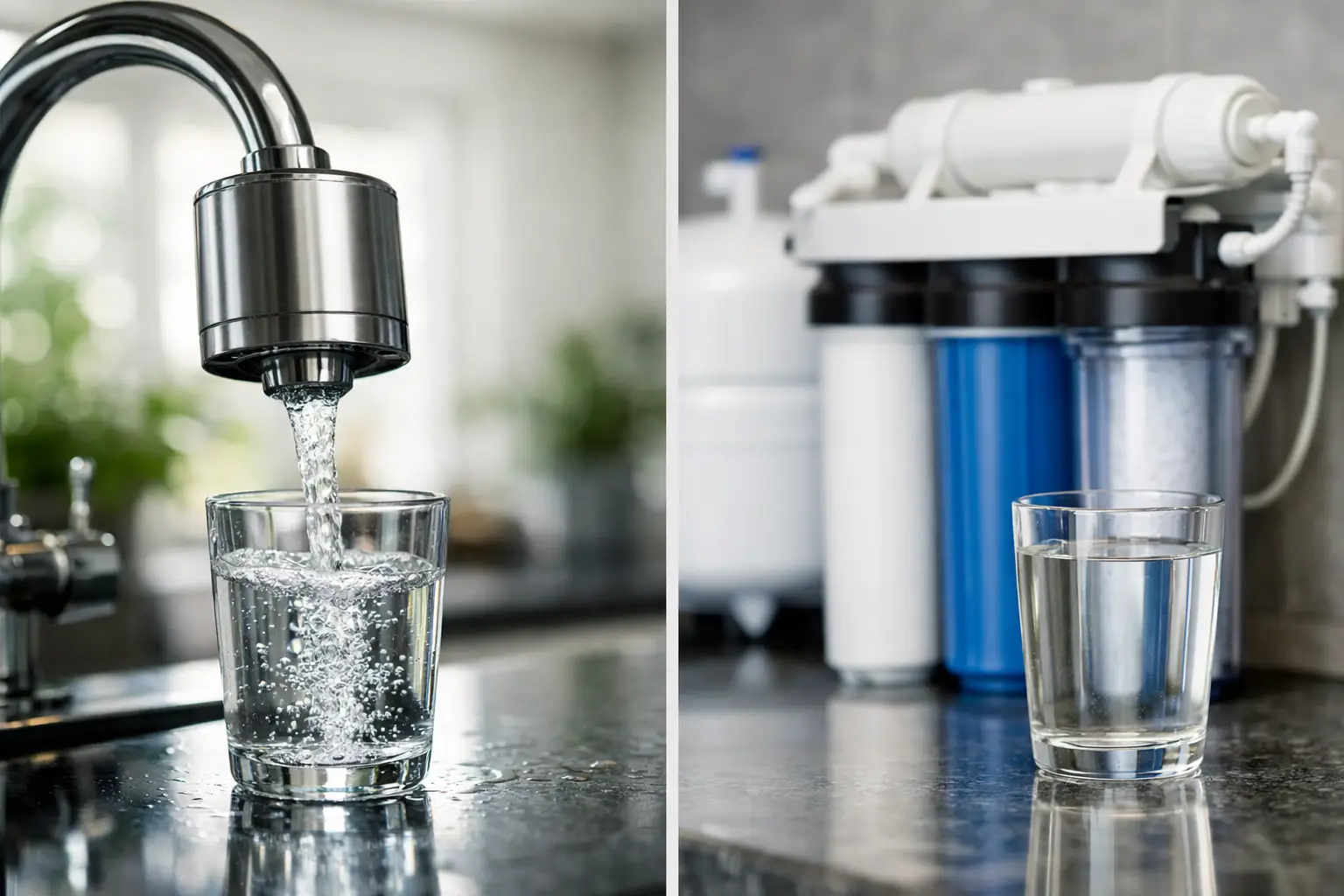
The question of water charger versus filters becomes much clearer when you stop asking which one is ‘better’. They are designed to meet different intentions. A filter works with the physical composition of water. A water charger is used as an intentional frequency-based practice, inviting you to relate to water as a carrier of life-force energy, presence and consciousness.
For many people, drinking water has become a rushed, forgettable act. Yet water is one of the few elements we welcome into the body every day. Choosing how you source, prepare and receive it can become a grounding ritual – one that supports greater awareness of your environment, your energetic boundaries and your relationship with your own biofield.
Water charger versus filters: two different roles
A water filter is a practical household tool. Depending on its design, it may reduce particular physical substances in a water supply, such as sediment, chlorine, certain metals or other contaminants. The results depend on the filter type, its certification, the condition of its cartridge and the specific quality of your local water. Filters require maintenance, and they are not interchangeable: a jug filter, an under-sink carbon filter and a reverse-osmosis system each work differently.
A Quantum Water Charger belongs to a different category of experience. In the Crystal Water Experience framework, it is not presented as a filtration device or a substitute for water-quality testing. It is a frequency-informed tool intended to support a conscious relationship with water through Quantum Frequency Trace Technology, focused attention and energetic practice.
This distinction matters. A charger does not physically remove sediment, pathogens, chlorine or metals. A filter does not claim to cultivate coherence, support an intention practice or help you develop frequency literacy. Trying to force one tool into the job of the other creates confusion. Let each serve its own purpose.
Start with physical water quality
Energetic sovereignty does not require abandoning common sense. If you are concerned about the physical safety or taste of your tap water, begin with reliable local information and suitable filtration. Your water source, plumbing, building age and regional treatment methods all shape that decision.
Someone living in a hard-water area may choose filtration primarily for taste and limescale. Someone using rainwater or a private supply may have different practical questions. A traveller may simply want a portable option that makes unfamiliar water more pleasant to drink. These are material considerations, and they deserve clear-eyed attention.
Think of filtration as caring for the physical vessel. It is a practical choice about what is present in your water at a measurable level. Replace cartridges as directed, keep containers clean and do not assume that a filter handles every concern. If water safety is in question, seek appropriate local guidance rather than relying on an energetic tool.
What a water charger adds to the ritual
Once the physical foundation feels considered, a charger can bring another layer to the experience: conscious participation. Rather than filling a glass and moving on, you pause. You notice. You set an intention for clarity, grounding, recovery after a demanding day or a more centred beginning to the morning.
For spiritually attuned people, this is not a minor detail. Your daily rituals teach your nervous system, attention and energetic field what you are available for. A moment of stillness with water can become a reminder that you are not here merely to absorb the noise of your surroundings. You can choose coherence.
Within a frequency-based worldview, water is approached as responsive to relationship, environment and intention. The charger offers a physical focal point for that relationship. It can sit within a wider practice that may include grounding, breathwork, meditation, EMF-awareness habits, prayer, visualisation or biofield hygiene.
The value is not in treating the device as a magic shortcut. The deeper value is consistency. When you return to the same intentional practice each day, you strengthen your capacity to sense your own state. You may begin to notice whether you are drinking in a hurry, carrying overstimulation from screens or social environments, or neglecting the simple acts that bring you back to your centre.
When using both makes sense
For many households, this is not an either-or choice. You may filter water for physical preference and then use a water charger as part of your conscious preparation. The sequence honours both dimensions: practical stewardship and energetic relationship.
This can be especially meaningful when your wellness practice is already built around discernment. You read labels. You care about the quality of what enters your home. You also understand that wellbeing is not limited to what can be seen, weighed or listed on a specification sheet. Your environment, attention, emotional state and sense of spiritual grounding shape your lived experience too.
A simple practice might look like this: prepare water from the source you trust, place it with your charger according to its guidance, rest your hands around the glass and take a few unhurried breaths. Rather than demanding a particular result, observe. What changes in your attention when hydration becomes an act of presence rather than another task to complete?
There is no need to make the ritual elaborate. The most supportive practice is one you will genuinely return to. A parent preparing a bottle of water before the school run, a practitioner resetting between client sessions or a person winding down after time in a busy city may all bring different intentions to the same moment.
Questions to ask before choosing
Your decision becomes simpler when you separate physical needs from energetic desires. Ask whether you need to address taste, sediment, a known local water concern or a particular filtration preference. Then ask whether you are also seeking a more intentional, frequency-conscious relationship with your drinking water.
Consider your lifestyle as well. A filtration system may involve installation, space and regular replacement parts. A charger may suit someone who wants to enrich an existing ritual without changing their plumbing. Neither choice needs to become a statement of purity or spiritual worthiness. They are tools, and the right tool is the one that serves your real circumstances.
It is also wise to examine expectations. If you want a device to remove physical contaminants, choose an appropriate filter and verify what it is designed to reduce. If you are drawn to water consciousness, life-force energy and subtle-energy practice, a charger may be a meaningful companion. If both matter to you, create a practice that gives each its proper role.
Beyond the comparison: reclaiming your relationship with water
The most interesting part of the water charger versus filters conversation is not the equipment. It is the invitation to become more discerning. Modern life encourages passive consumption: drink quickly, scroll continuously, adapt to overstimulation and carry on. An intentional water practice offers a small but potent refusal of that pattern.
Crystal Water Experience approaches this territory through tools and teachings that invite personal observation rather than blind belief. Your body, awareness and daily experience are part of the inquiry. Notice how you feel when you bring more presence to hydration. Notice the quality of your attention before and after your ritual. Notice whether regular pauses help you feel more grounded in your own energy.
Water does not need to become another wellness obligation. Let it become a meeting point: between practical care and spiritual awareness, between your physical body and your subtle field, between the pace of the outer world and the sovereignty you are choosing to cultivate within.