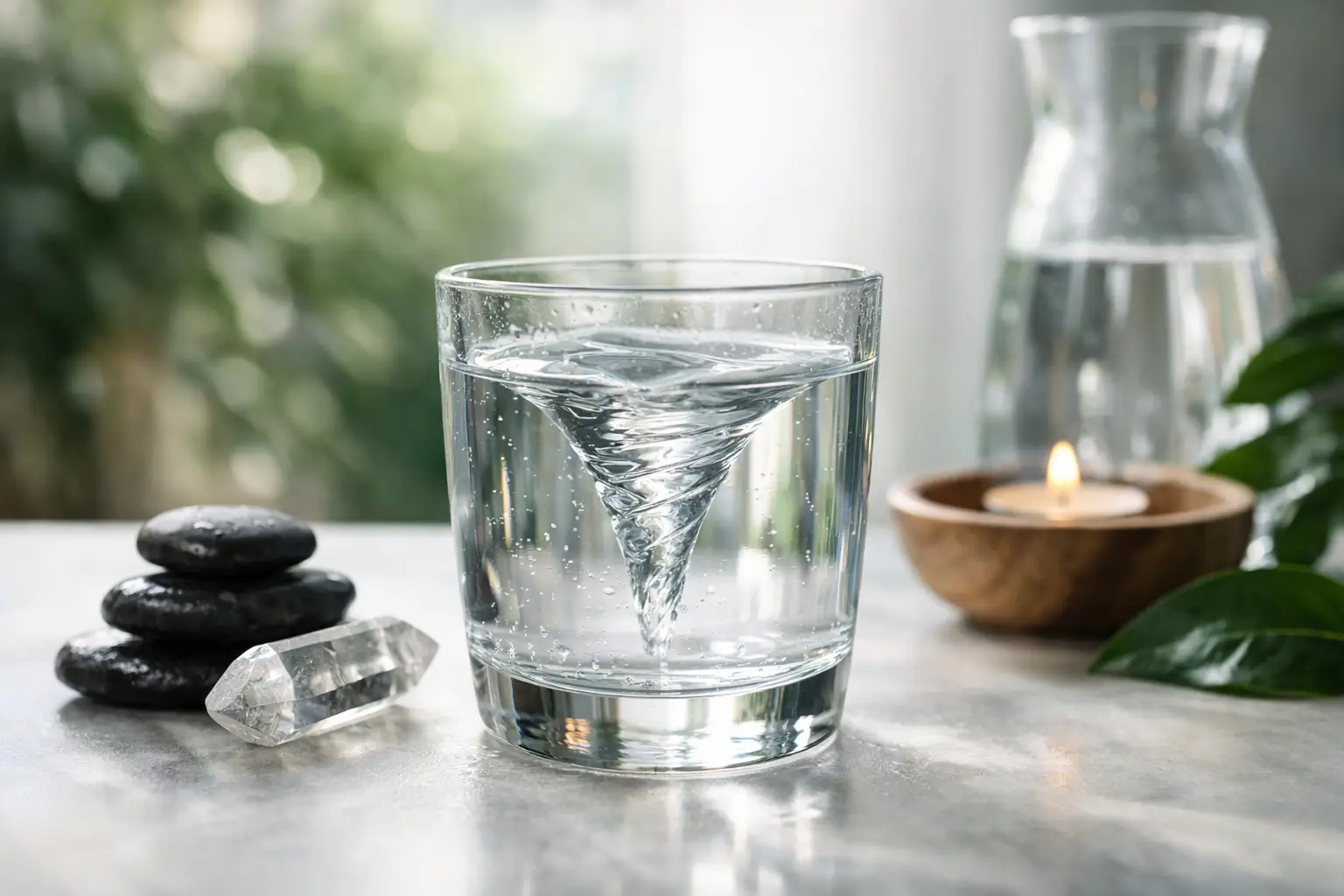
A glass of water can be more than a pause between tasks. It can become a moment of return: hands around the vessel, breath slowing, attention leaving the noise of screens and demands. This is where conversations about structured water benefits become meaningful – not as a promise of a miracle, but as an invitation to work with hydration, frequency and conscious ritual in a more intentional way.
For people exploring energetic wellbeing, water has long held a special place. It is responsive, receptive and central to life. The question is not simply whether water is clean enough to drink. It is also how we relate to it, what quality of presence we bring to it, and whether our daily habits support a more coherent inner state.
What do people mean by structured water?
“Structured water” is an umbrella term, and it is used differently across wellness, scientific and spiritual communities. In alternative wellness spaces, it commonly refers to water believed to have a more ordered molecular arrangement than ordinary bulk water. You may also hear terms such as hexagonal water, exclusion-zone water, coherent water or energised water.
In practical terms, people seek to influence water through movement, vortexing, minerals, light, sound, intention, electromagnetic fields or frequency-based devices. Within a consciousness-led framework, water is viewed not only as a physical substance but also as a medium that may interact with environment, information and life-force energy.
There is a distinction worth holding with clarity. Water science is complex, and claims that a particular device or method creates a stable, health-enhancing “structured” state in drinking water are not established by strong clinical evidence. Water molecules continually form and break hydrogen-bond networks, especially at ordinary temperatures. That does not make your personal experience irrelevant. It means the most grounded approach is to avoid turning an energetic practice into a medical certainty.
Structured water benefits through an energetic lens
The potential benefits people describe are often experiential rather than clinical. They may report that water prepared with care feels smoother, more refreshing or easier to drink. Others find that a dedicated water ritual helps them stay consistent with hydration, regulate their pace and reconnect with their body throughout a busy day.
That consistency matters. A person who creates a meaningful morning water practice may naturally drink more regularly, pause before reaching for another coffee, and become more attentive to what their body is asking for. Those are tangible shifts, even when they cannot be reduced to a single molecular explanation.
From an energetic perspective, the practice may also support a sense of coherence. Coherence is not about forcing yourself into permanent calm. It is the felt experience of being less scattered – your thoughts, breath, body and intention moving in a more unified direction. For many people, this is the real value of conscious water work: it creates a repeatable gateway back to centre.
Water consciousness and intentional attention
Water consciousness is a spiritual framework, not a settled scientific conclusion. It proposes that water may be sensitive to subtle influences, including the emotional and environmental field around it. Whether you interpret this literally or symbolically, the practice can still be powerful.
When you offer gratitude before drinking, speak a clear intention, or hold a glass while grounding through your feet, you change the quality of your own attention. You are no longer consuming automatically. You are participating.
This is an essential distinction for energetic sovereignty. Your power does not depend on a product, a practitioner or a perfect ritual. Tools can support your practice, but the relationship you build with your own awareness is the foundation.
What may support the experience of structured water?
The physical fundamentals come first. Start with water you trust, appropriate for drinking, and keep your vessel clean. If local water quality is a concern, seek reliable local guidance and use a suitable filtration approach. No energetic method substitutes for safe water.
From there, you can explore supportive practices. Gentle swirling or vortexing can make the preparation feel ceremonial. Natural mineral content may affect taste and is part of why different waters feel distinct. Spending time outdoors, receiving daylight and reducing the frantic pace around meals and hydration can also reshape how the body receives a simple glass of water.
Frequency-based tools are another avenue for those called to subtle-energy exploration. At Crystal Water Experience, Quantum Frequency Trace Technology is used within a broader approach to water consciousness, biofield awareness and intentional practice. The point is not to hand over your discernment to a device. It is to pair the tool with observation: notice your hydration habits, your energy, your sense of presence and the quality of your ritual over time.
Your environment matters too. If you are drinking water while doom-scrolling, rushing out the door or working through a state of constant stimulation, the nervous system receives a very different message than when you pause, breathe and arrive. This is not an argument for perfection. It is a reminder that energetic hygiene is built through small, repeated choices.
A simple structured water ritual for daily coherence
Begin with one glass rather than an elaborate protocol. Choose a time you can protect – perhaps shortly after waking, before meditation or at the transition from work into evening.
Hold the glass with both hands. Let your shoulders soften and take three unhurried breaths. Feel the contact of your feet with the floor, or step outside if that is available to you. Grounding does not need to be dramatic. It is simply the practice of returning awareness to the body and the Earth beneath you.
Then offer an intention that is specific and believable. “May this water support clarity and steadiness” is often more useful than a grand declaration you do not genuinely feel. Drink slowly enough to notice temperature, taste and the movement of swallowing. Afterwards, take ten seconds to sense your state without trying to manufacture an outcome.
Practised daily, this becomes a form of frequency literacy. You learn to recognise the difference between rushing and receiving, depletion and replenishment, fragmentation and coherence. The water is part of the ritual, but so are you.
How to evaluate claims without closing your intuition
Alternative wellness can become confusing when every new method is presented as the missing key. A discerning path makes room for both wonder and questions.
Be cautious of any structured-water claim that promises to cure illness, replace prescribed treatment, detoxify every problem or make ordinary hydration rules irrelevant. Individual needs vary, particularly for people with kidney, heart or other health conditions that affect fluid intake. For medical concerns, consult a qualified healthcare professional.
At the same time, do not dismiss your own observations simply because they are personal. Keep a small journal for two weeks. Note how much water you drink, when you prepared it with intention, how your body felt and what else was happening in your day. Look for patterns, not proof. The goal is not to win an argument about water. It is to develop a more honest relationship with your lived experience.
The trade-off: ritual versus rigidity
A water practice should create spaciousness, not another rule to fail. If you miss a day, drink ordinary water without fear. If you travel, use what is available and return to your ritual when you can. A coherent practice is flexible enough to serve real life.
It also helps to keep the hierarchy clear: safe water, adequate hydration, nourishing food, rest, movement, emotional support and meaningful connection are not replaced by frequency work. They provide the ground from which subtle practices can become more useful and sustainable.
The deepest benefit may be surprisingly simple. Each time you prepare water with care, you practise the truth that your attention has direction. You can meet an ordinary daily act as a conscious creator of your own field – one breath, one intention and one glass at a time.